Tuesday, February 28, 2006

reverence

Sunday was the Feast of the Transfiguration, and we had a sermon on reverence at church. In passing, our Reverend reflected on the lack of reverence in the modern world... he lamented the passing of a time when Australians were, by and large, godfearing and reverence towards things like sex and religion was part of the culture.
I've been thinking about the sermon and about the issue of 'reverence'. It seems to me that if it is indeed true that our society is less reverent, there are significant reasons for that. For most westerners at the end of the twentieth century, it might seem fairly obvious that reverence is a dangerous attitude. Reverence towards governments ends up with all your young men dead in wars that have nothing to do with you, reverence towards the church results in a nightmarish plague of abuse, reverence towards sex leaves people ignorant and afraid... and reverence towards God seems to create a culpable blindness that allows such horrors to be perpetuated. For us in the church, shouting at people 'BE MORE REVERENT' doesn't seem like much of a solution. And reverence in itself is surely not what God desires. It's reverence towards God, and God understood in all his grace and goodness.
Surely it's only as we reflect our own reverence for God... in a respect for his world, in a profound valuing of all the people he's made, in a rejection of the false gods of money and power, in persevering at building a community that is made up not just of people like us but of all who confess their need of God's grace, in the constant telling and retelling of the stories he has told us about himself, in a humility about ourselves and our own opinions... surely that's when people will see a reason for reverence.

Thursday, February 23, 2006

writing and seduction

Another thought from the writing masterclass, on writing as a love affair. The speaker suggested that in a book (as opposed to in a thesis) we aim to seduce the reader, to make them fall in love with our voice. This means that the topic of the book is almost an excuse: we want the reader not to love our subject, but to love our 'take' on that subject. We are jealous (in the OT sense of a 'jealous' God!) of our readers' affections and attention, wanting them to be wholly ours. This has particular significance for the way we quote others. In a thesis, we quote others as 'authorities', because we are not presenting ourselves as authoritative. Their voices lend weight to ours. But in a book, we are careful not to allow the voices of others ever distract the reader from our, central, authoritative voice. To use the speaker's example, we would not want someone to sleep with us because we were friends with Kant'. But we might tell a joke about Kant to make ourselves look intelligent and attractive!
Again, I'm beguiled (I should say seduced!) by this analogy. But is writing really such an egotistical activity?

Wednesday, February 22, 2006

writing and virtue

I spent yesterday at a masterclass on writing for postgraduates in the humanities. A stimulating day, hearing from a number of academics who write for broader audiences than just those within their field. One of the speakers got me thinking about the importance of hatred in thinking and writing. He argued that (among other motivations) most of us are driven by a hatred of a particular approach to our subject. While this hatred is important and valuable as a motivation, it must not infect our writing, which has to be (his word!) 'lovely'.
Interesting! I realised that I do indeed hate (quite passionately) a particular, long-standing approach to Methodist history which to my mind has flattened an entirely fascinating religious culture into a bland, respectable, deathly boring set of theological propositions. And I am certainly driven by that hatred to write about early Methodism in a way that will somehow rescue it from that fate. The question is, do I embrace that hatred or regard it with suspicion? After all, I don't hate the people who've written the books I detest - I meet them at conferences and they are kind and delightful people. But hatred of an intellectual approach does spawn a lack of respect for people, an arrogance about my own ideas, a sneering attitude towards particular schools of thought. And that doesn't seem very virtuous!

Monday, February 20, 2006

At the tent flap sin crouches.

I've long been a fan of Robert Alter and his sensitive approach to the biblical texts. His book The Art of Biblical Narrative transformed my understanding of the OT. He has recently published a translation of the Pentateuch - James Woods has an excellent review here. Thanks to Greg for pointing it out!

Wednesday, February 15, 2006

right to work

In one of my first entries on this blog, I wrote about my time visiting asylum seekers in detention here in Melbourne. I haven't been out to the detention centre for a while, because there are hardly any asylum seekers kept in detention here anymore - the overall numbers of people in detention have dropped and those who are still in detention are kept well out of the public eye in desert centres.
The situation for those asylum seekers who have been allowed into the community is not great, however. In particular, there are around 7000 people who have been issued a visa called the Bridging Visa E. Under this visa people are not allowed to work and given no access to Medicare. That's right, they have no source of income and no way of paying their bills. If their children get sick, they can't take them to the doctor. I heard of one man who accidentally cut his finger off and didn't go to hospital because he knew he had no way of paying the bill.
These people are entirely dependent on charity. It is an absolutely disgraceful situation. The Uniting Church has begun a campaign to change the conditions of the Bridging Visa. If you're an Australian, please join the campaign. TEAR Australia has information and a letter-writing guide.

Friday, February 10, 2006

beards

February heralds an influx of PhD students back into the building I work in, prompting the question: is there some kind of deep connection between PhDs and beards? I rarely see a beard away from university, whereas a male postgrad without a beard is notable. And once Andrew and I were at a work dinner for one of the organizations he works with... table after table of cleanshaven men in business suits. Andrew said he'd introduce me to some of the scientists who work for the organization - and there they were, a row of boys with beards. I felt immediately at home.
What's with beards? And is there a female equivalent?

Royal Society

After reading Neal Stephenson's Baroque Trilogy, I have the entirely ridiculous notion that I am on intimate terms with the 17th century scientists who were members of the Royal Society (Newton, Wren, Hooke and co.) I'm therefore delighted to see that the Society minutes have been discovered in someone's cupboard.

Thursday, February 09, 2006

what I do (and why)

I recently applied for a writing course and was required to submit a 500 word piece of writing, describing my research in a way that would be accessible to the general (educated) reader. Writing it made me aware of how attached I have become to certain academic norms - it seems sacrilegious to include quotes without footnotes, and I keep feeling the desire to qualify every statement. Here's what I wrote:
The history of human suffering divides naturally into the time before the invention of anasthetics and the time after. We who live in the latter time may find ourselves reluctant to imagine the experience of those who lived without the comfort of relatively effective pain relief. Theirs was a world in which a blow to the head was one of the few possible preparations for surgery; in which toothache drove people to suicide; in which a peaceful death was a rare blessing. Theirs is the world in which I immerse myself, in my study of the experience of suffering in eighteenth-century England.
Consider the description of a mastectomy sent to Charles Wesley, the Methodist revivalist and hymn-writer, in 1758. Entitled 'An account of Mrs Davis' behaviour during the operation of her breast being cut out', it is written by a friend who attended the operation. She writes of Mrs Davis:
'When the inside of her breast was taken out, she asked if they had done cutting. I answered yes, and some thread being called for, she immediately said 'There is some in my work basket on the table'. While they sewed up the blood vessel, she said 'This pain is very great'. She called on the Lord to strengthen her and said 'I'm faint'.'
This account is matter-of-fact in its description of details: the call for thread, the calm instruction by Mrs Davis, the sewing up of the flesh. Reading it, the imagination revolts. How did men and women endure such pain?
The very existence of this account suggests the importance of this question to those who wrote and read this description as well. Charles Wesley and the anonymous woman who composed this account were involved in the Methodist movement. Methodism was a revivalist sect within the Church of England that grew with staggering rapidiy during the eighteenth and nineteenth centuries, becoming in the process an established international denomination. As this account suggests, Methodists took a profound interest in a person's behaviour while in the crucible of physical agony. Mrs Davis's self-control in the face of suffering was evidence of the strength of her faith and so worthy of description to her fellow-Methodists.
In their journals and letters, in their hymns and sermons, Methodists explored the meaning of suffering and the means by which it could be managed and endured. Through reading these texts, I seek to answer the questions that intrigue me. What did suffering mean to Charles Wesley and his fellow Methodists? What shaped their responses to the physical and emotional pains of life? How did they maintain their faith in a loving (if stern) God in the face of horrors such as these? The answers to these questions are not only important for understanding this influential religious movement and the culture within which it developed, but they also provide a historical context within which we can reflect on the hard questions that the experience of suffering continues to provoke.

Tuesday, February 07, 2006

quote

'Once during my time teaching in Wesley College, after four terms taking a particular class through the history of the church in the ancient world and the Middle Ages, one of my students asked in despair "But where is the good news in all of this?" It was a fair question, to which I could best reply that all the story was good news. The history of Christianity is frequently sordid and depressing, and very frequently, apparently sacred events turn out to have very secular causes. Christians will remain beginners in their faith if they do not face up to this. The miracle of the church's story is that after all its mistakes, bewildering transformations and entanglements in human bitterness, it is still there'

Diarmaid MacCulloch, Groundwork of Christian History, p 11.

Monday, January 30, 2006

Israel

I went to two church services (at two different churches) on Sunday, and at both I heard prayers about Israel that distressed me. It's not that I worry that God will be swayed by unwise prayers (I certainly give him plenty of practice at resisting ridiculous requests). Evangelical foolishness about Israel continues to do plenty of damage, however, and to see it surfacing among fairly sensible people is alarming. For a good summary of the theological problem, I point you to Faith and Theology. For a jeremiad that I am inclined to agree with, (and which my experience on Sunday confirms), I point you to this post by Myles.
In the meantime, I'm resolving to spend more time praying for peace, which pleases God, who desires that all people be saved.

methodist monday (2)

Last Monday I commented that my reading of Methodist letters suggested that 'ordinary' people were often theologically aware and engaged. I've just been re-reading a couple of letters from a woman named Sarah Mason, who wrote to the Wesley brothers in the 1740s explaining her theological position. She gives a thorough defense of her moderate Calvinism, and demonstrates a clear understanding of the debates surrounding election. For example:
...though I cannot say I can fully close in [agree] with everything I hear, yet I have reason to bless God that I have heard what i trust has been made of use both for instruction and establishment in the faith once delivered to the saints... As to the doctrine of universal redemption what must I say, methinks Christ did in some sense die for all because the Scripture tells me he tasted death for every man - and that he is the Saviour of all men (but especially of them that believe) - but that he died in the fullest snese for and intentionally to save all the fallen race methinks it cannot be; because how then is it that all are not actually in the fullest sense made partakers of complete and eternal salvation.
She goes on to discuss a number of passages in Mark, and rejects the doctrine of reprobation. In another letter she quotes Hebrews 12:23 to argue that perfection is not possible in this life. She concludes:
The great restorer of all things is not yet come in that way we are waiting for, and it is with pleasure I think of those words, "He restoreth my Soul" (and those "I am the Lord that Healeth thee"). I believe it is through grace, under his healing hand; and that it is not in the power of men, or devils to pluck it thence... and methinks to this sorry, sinful soul of mine, these words are sweetly encouraging.
Again, I think these letters show both a theological awareness and a conviction that theology had significance for daily life. For both Sarah Wesley and Sarah Mason, too, their theological convictions were 'sweetly encouraging' in the face of life's trials.

Friday, January 27, 2006

Indigenous poverty

To commemorate Australia/Invasion Day (which was yesterday), I'd like to draw attention to the Make Indigenous Poverty History campaign. Many indigenous Australians live in poverty; their children are twice as likely to die in infancy; they suffer higher unemployment and are six times more likely to be murdered than the average Australian. The National Aboriginal and Torres Strait Islander Ecumenical Commision (NATSIEC) has begun the Make Indigenous Poverty History campaign to draw attention to this apalling state of affairs and bring about meaningful change. Check out their website, and if you're an Australian, get involved.

Monday, January 23, 2006

methodist monday

I thought I'd blog a little on my research. I've been reading through stacks of unpublished letters, written in the eighteenth century to Charles Wesley, hunting for letters about suffering - sickness, bereavement, persecution, childbirth. It is sad reading, and sometimes it feels morally questionable to be reading letters which share such private thoughts and feelings. And yet it's fascinating to have the opportunity to listen to these long-dead Methodists, to hear how they understood and managed the terrible pains that eighteenth-century life so often brought.
There are hundreds of letters to Charles from his wife Sally. I've been looking in detail at the letter she wrote to inform him that one of their sons had died. She wrote:
My Dearest Mr Wesley,
This comes to acquaint you that our dear little Babe is no more, his agony is over but it was a hard struggle before he could depart, He was dying all yesterday from two o'clock and about 9 last night he departed. He screamed three times about half an hour before he died, that he could be heard from Nurse's Parlour to the other side of the street, not through guilt (that is my comfort) but through extreme pain, perhaps were I of Calvin's opinion I might have attributed it to a different cause, but glory be to a blessed Redeemer's love for declaring (for the consolation of distressed Parents) that "of such is the Kingdom of Heaven". O that I may land as safely in the harbour of eternal Peace...
It's a deeply moving letter. And I am struck that at the most intimate level of this eighteenth-century woman's grief over her dead son, theological debates mattered. So much English history is written as though theology had meaning only for the elites, while 'popular' religion was a matter of superstition and learned ritual. The letters I'm reading suggest that quite complicated theological debates were a matter of genuine and practical concern for the working classes. Where theology dealt with life and death (including who would be saved and how) people took notice.

Friday, January 20, 2006

icons


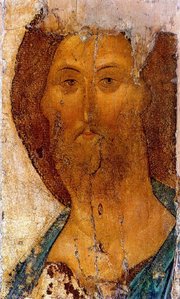
I've just signed up for a course on icon painting... something to broaden my Protestant mind (although as my Lutheran friends like to remind me, Luther was keen on icons) and exercise the left side of my brain. This icon by Andrei Rublev has me all inspired...

hurrah!

I have just finished my rough draft of the final chapter of my thesis! Lots and lots of rewriting to do, but it feels like a milestone passed.

Wednesday, January 18, 2006

Easter hymn

I spend my days studying hymns, but my new favorite is the Easter hymn Ben's daughter composed. I also enjoyed the sophisticated theological analysis provided by Ben (though as a cultural historian I would have liked him to pay a little more attention to the cultural function of her composition). Thanks to the tortoise of dissent for pointing it out.

Tuesday, January 17, 2006

the thesis writer's friend

The submission date for my thesis is looming, and I am spending much of my time trying to think through difficult theoretical questions that I've avoided for the last three years. My hot tip for this kind of intellectual dilemma is: go swimming! Yesterday I was wrestling with a thorny theoretical problem and took time off for some laps. First ten laps: mind in state of total confusion. Second ten laps: meditative calm. Third ten laps: effective mental effort. Fourth and fifth ten laps: solution to problem emerges as if by magic. This has happened more than once - somehow the repetition and physical effort does wonders for my mind!

Friday, January 13, 2006

and now for something completely different...

An interview with the Russian detective novelist, 'Boris Akunin'. (yes, that's B.Akunin for the Russian historians among you). I've just been enjoying his book 'The Turkish Gambit', set in nineteenth-century Russia and featuring a rollicking combination of spies, generals, Turks and a 'progressive' Russian heroine. In the interview Akunin talks about the contempt with which Russians regard 'popular fiction'- his mother is still waiting for him to write a 'real' book. And he refuses to do public appearances in Russia because (he says) Russians expect novelists to know the meaning of life. Earnest young men are apparently always asking him whether there's a God! Hm, yes, just like Australia...

Wednesday, January 11, 2006

Shadowmancer

Andrew and I have been reading G.P. Taylor's book Shadowmancer to each other. We like to have a good kid's book to get us through the housework (one person reads, one person folds the clothes/washes the dishes/ makes dinner). I know Shadowmancer has had some rave reviews, but frankly I'm disappointed. There's some good stuff about it: the setting (Cornish coast, 18th century) is atmospheric, and the introduction of demons and witchcraft into that gloomy and superstition-ridden context entirely effective. Having a vicar as the villain is a nice touch! But it just seems far too clunkily... Christian. Whole sections of the narration and dialogue are taken straight from the Bible or are oddly tract-like. What we can't work out (given that it seems to have sold really well) is whether it just grates on us because we went to Sunday School. Are there hundreds of kids out there who read a description of the dark lord as 'a prowling lion, seeking to devour you' and think it's a strikingly original image? Perhaps there are!